

In the name God who is beautiful and loves beauty
Handicrafts:
Iran is considered a land in which there is the most variety in handicrafts all around the world. In every corner of this land, there are masters who are working in different fields of Handicrafts and give birth to Art in various ways.
They give birth from nonexistence a beautiful creature whose roots are in their minds and philosophically is exclusive. Presenting the art of the women and men of this land is the concern we have been involved with for so long. Thereby we decide to draw international attentions to support our artists by presenting these industries and their products.
Inlaid work
Introduction
No one exactly knows for sure that who invented and used this art for the first time and some even refer it to Abraham the prophet and consider it as one of his miracles. In many places in the Middle East you can visit this art whose roots prove its long history. Some inscriptions, found in Egypt in early Islamic era, the preaching stairs in Atiqh mosque in Shiraz which dates back to 1000 years ago, the roof of main porch of this mosque which dates back to 600 years ago, the wooden door beside bone coverage and other woods which date back to 600 years ago in museum of Berlin and other samples present the long history of this artistic technique in the region and especially in Iran.
Nowadays you can visit the acme of this art in Esfahan, as in Safavid era the masters of this technique gathered there by the order of Shah Abbas the great to create great masterpieces. The good context at that time made this art and its artists blossom. After Safavid era, domestic battles caused a lot of damages on artists and really hurt the art in many aspects. In the beginning of Pahlavi era, the school of fine arts was established by Kamalolmolk which gave the Iranian handicrafts a new spirit.
Since that time, this art, has been developing and even after the Islamic revolution the Islamic Iranian motifs besides Islamic calligraphy vanished dominantly the European motifs.
Technic explanation:
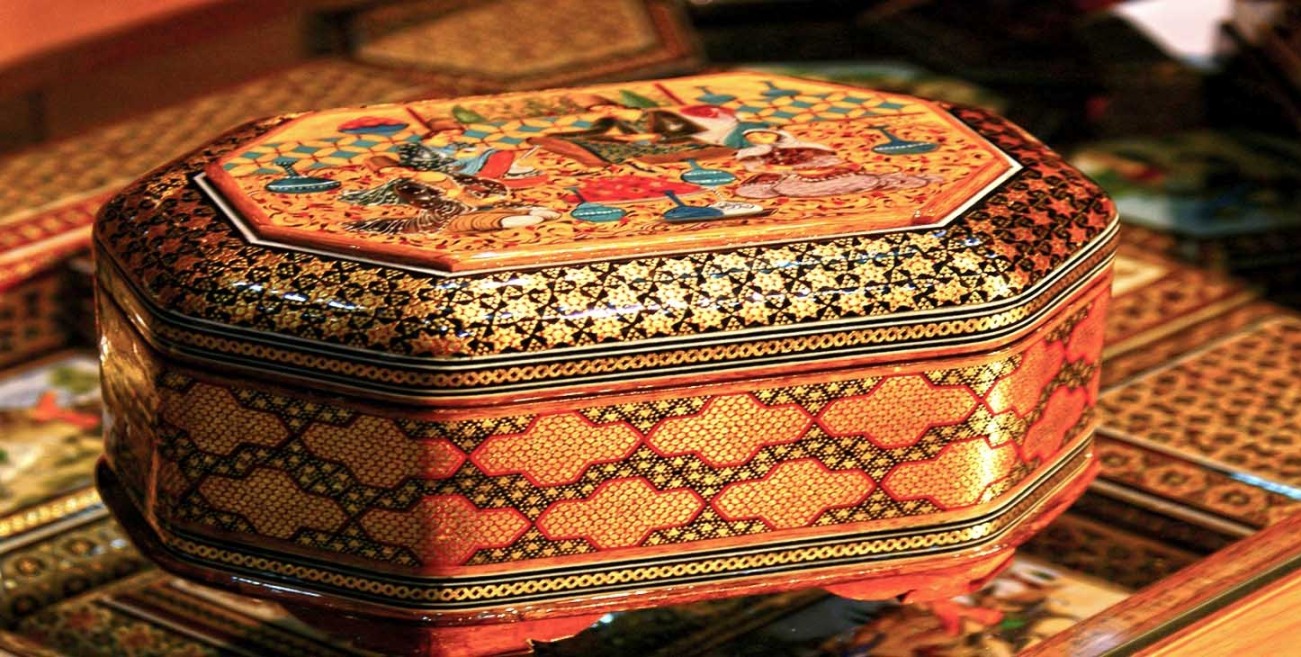
The inlaid is a combination of some regular polygons in different shapes and in different colors made of various materials. This technique needs a lot of patience. All of the inlaid plans are shaped of geometric shaped, using triangular shapes next to each other. It is usually made of wood, iron and bone. The smaller the triangles are, the high quality and expensive the inlaid work would be. To make the smallest geometric unit they use three triangles and to make the biggest one they may use even four hundred triangles in one plan.
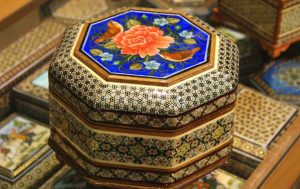
The materials which are used are usually different types of woods including ebony, betel nut, walnut, logwood, Jujube, sour orange and aspen plus camel’s and horse’s bone and ivory plus irony wires made of bras ad aluminum and sometimes silver plus shell, flint, glue and lac.
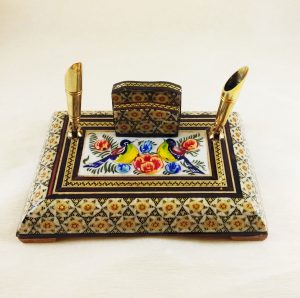
To produce inlaid, at first they provide different woods and bones in different colors and cut them in 30 centimeters sizes and 1 to 2/5 diameters by which the triangles are made. After smoothing all of the sides, in order to complete the plan they need wires in triangular shape. To prepare them, there are some processes like drawing, connecting them by glue and yarns. After some hours the yarns are detached and the smoothing phase would begin. These triangles come together by wires and glue to present a star shape. So many stars are produced together and next to each other and later the narrow layers of wood are attached.
After 400 phases the inlaid work is ready. In the end they polish all of the parts to make them nicer and stronger.
The features of a high quality inlaid work:
- The smoothness of surface
- The similarity in color and shape on every part
- The repairment should not be apparent
- The harmony and symmetry in shapes and flowers
- The smaller the plans, the high quality and valuable the work is
The products:
Jewels boxes, tissue boxes, doors etc.
The cities of production:
Esfahan and Shiraz
